If you run a heat-setting or finishing line, the stenter chain is one of those parts you only think about when something goes wrong. Yet this endless chain—running on both sides of the machine, carrying your fabric edge by edge through the hot-air chambers—directly controls fabric width, straightness, and tension stability. When the chain runs true, quality looks effortless. When it starts to wear, problems show up first on the fabric, long before they show up in a maintenance log.
What Is a Stenter Chain?
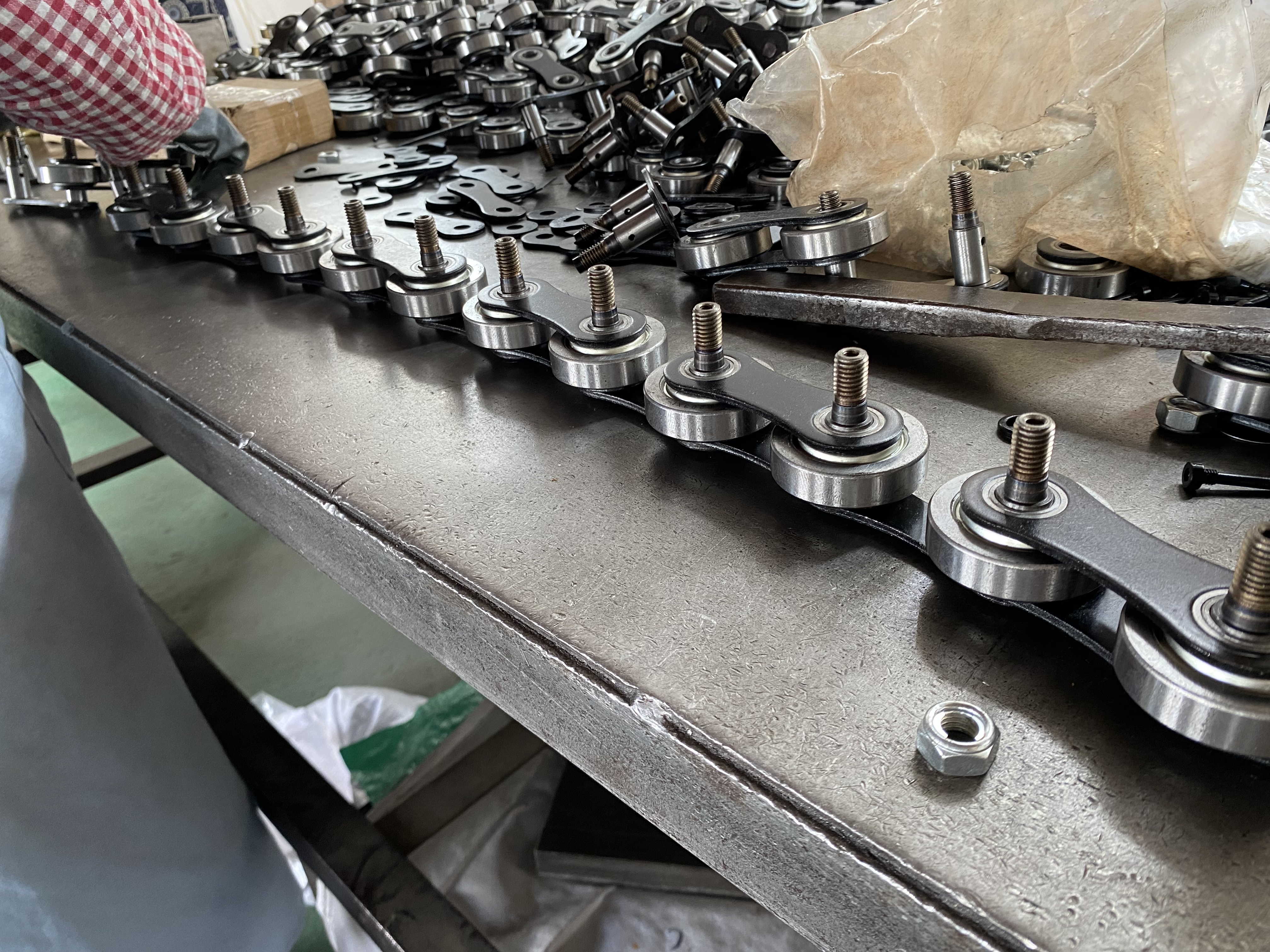
A stenter chain (also called a tenter chain or pinning chain) is the endless conveyor system that grips the selvedges of a fabric web and carries it through the stenter machine at a controlled width and tension. The chain runs on two parallel chain rails, one on each side of the machine, and its working width can be adjusted to match the required fabric width.
Its job is threefold:
- Hold the fabric edges securely while the web is stretched to the target width;
- Transport the fabric through the heating chambers for drying and heat-setting;
- Control tension and overfeed so the finished fabric has stable width, straight weft, and no distortion.
In effect, the chain is what turns a moving web of cloth into a dimensionally stable finished product.
How the Chain System Works
At the entry of the machine, the fabric selvedge is fed onto the pins or clips mounted on the chain. The chain then moves through a series of hot-air chambers, where the fabric is dried and—for synthetic fibres such as polyester—heat-set at typical temperatures of around 180–210 °C (broad range roughly 160–220 °C). After the cooling section, the chain releases the fabric at the delivery end and returns, empty, along the outer path back to the entry, forming an endless loop on each side.
Two basic gripping systems exist:
- Pin chain (needle plate chain): rows of fine, sharp pins mounted on needle plates grip the fabric edge. Pin stenters are the standard choice for woven fabrics, because the pins hold the selvedge reliably at high overfeed and under tension.
- Clip chain: mechanical spring clips hold the fabric edge without piercing. Clip stenters are often used for knit fabrics or delicate materials that would be damaged by pinning.
The choice of pin or clip, the pin spacing, and the chain pitch are all matched to the fabric range and the machine model—which is one reason why "identical-looking" spare chains are not necessarily interchangeable.
Key Components of a Stenter Chain
A modern stenter chain is not a single part but a precision assembly. The main components include:
- Chain links: the load-bearing body of the chain, usually made of heat-resistant alloy steel. The links carry the pin plates and transmit the driving force along the chain.
- Needle plates / pin plates: the replaceable parts that carry the pins. Because they contact the fabric continuously, they wear first and are the most commonly replaced component.
- Pins: fine, hardened-steel pins that pierce the fabric selvedge. Pin straightness and spacing directly affect pinning accuracy and edge quality.
- Lubrication system: an automatic (or manual) system that feeds high-temperature chain oil to the link and pin interfaces.
- Chain rails / tracks: the cast-iron or steel guides on which the chain slides. Seasoned, distortion-free rails keep the chain running straight at temperature.
Because the chain operates continuously at high temperature and under tension, every one of these parts is a wear item in the long run—the question is simply which one fails first, and how much unplanned downtime it causes.
Why Stenter Chains Wear Out
Chain wear is normal, but uncontrolled wear is expensive. The most common failure modes are:
- Chain elongation: the single most common cause of stenter problems. As pin joints and link bores wear, the chain physically lengthens. A slightly elongated chain causes pinning misalignment and uneven fabric tension; a badly elongated chain can cause the chain to skip or derail.
- Pin and needle plate wear: bent, blunted, or missing pins damage selvedges and cause dropped selvedges ("unpinning") at speed.
- Lubrication failure: at 200 °C, ordinary oils carbonize and turn to varnish. If the high-temperature chain oil runs out—or the wrong oil is used—friction spikes, pins seize, and wear accelerates dramatically.
- Rail and track wear: worn or distorted rails make the chain run out of true, producing side-to-side fabric wander and width instability.
- Thermal and mechanical stress: repeated heating and cooling, plus tension, can distort links over time, especially in machines pushed to their speed limit.
The pattern is worth noting: by the time fabric quality drops, the chain is usually already well past its service window. That is why inspection should be a schedule, not a reaction.
Maintenance Best Practices
With the chain, an hour of planned maintenance is worth a day of unplanned downtime. A practical maintenance routine looks like this:
- Lubricate on a schedule, not by eye. Use OEM-approved high-temperature chain oil, often silicone- or PTFE-based, formulated for stenter conditions. Automatic lubrication is strongly recommended; if you lubricate manually, set a daily routine.
- Measure elongation, don't guess it. Track pin-to-pin distance over the full chain length at regular intervals. Catching elongation early lets you plan a replacement during a shutdown instead of a mid-production breakdown.
- Inspect pins and needle plates. Look for bent, worn, or missing pins and cracked or carbonized needle plates. Replace worn plates before they start marking the fabric.
- Check the rails and guides. Look for scoring, gapping, or distortion, and keep the track clean of fiber and lint buildup.
- Run both chains in sync. Uneven tension between the left and right chains causes skew and width drift, so check chain tension on both sides together.
- Keep records. Log lubrication intervals, elongation measurements, and replacement dates. Trends in the data tell you when a component is degrading before it fails.
When to Replace—and How to Choose Spare Parts
There is no universal "chain life" number; it depends on operating temperature, speed, fabric load, and lubrication discipline. The signs that replacement time is near are clear: elongation beyond the manufacturer's tolerance, recurring unpinning, visible fabric edge damage, and repeated pin jams.
When the time comes to buy a stenter chain or needle plates, the practical points are:
- Match the exact machine model. Chain pitch, pin spacing, link geometry, and pin count are model-specific. A "universal" part that is not engineered to your machine will not pin straight.
- Choose the right material. Heat-resistant alloy steel with correct hardening is essential—cheap steel loses hardness at operating temperature and wears out in months.
- Buy replaceable wear parts as a system. Needle plates and pins are designed to be replaced; keeping a small stock of the fast-wearing parts avoids long lead times.
- Verify straightness and consistency. The pin line must be straight and uniform along the entire chain; small manufacturing tolerances compound into visible quality problems at full speed.
Need the right parts?
Changzhou Winwell International Co., Ltd. supplies pin plates, chains, pin clips, brush assemblies, and matched spare-part sets for all major stenter makes and models, with in-stock availability and worldwide shipping. Our team can help you identify the worn parts behind your defect and supply replacements fast.
Molly Wang — Sales Manager

